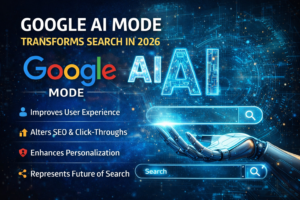
The way people search for information online is undergoing a major transformation thanks to advances in artificial intelligence (AI). At the forefront of this shift is Google AI Mode, a feature within Google Search that blends traditional search with generative AI capabilities. Rather than simply returning a list of links, AI Mode can interpret complex multi‑part queries, generate comprehensive answers, and even perform tasks using integrated AI reasoning. This new search experience is reshaping user behaviour, the role of SEO, and the economics of online content — fundamentally changing how we think about search in 2026.
Below, we explore how Google AI Mode works, how it differs from classic search, and the wide‑reaching impact it is having on search results, publishers, users, and businesses.
1. What Is Google AI Mode?
Google AI Mode is a search feature within Google Search that leverages the company’s advanced AI models to interpret and answer user queries in a more conversational and intelligent way than traditional search.
Introduced in early 2025, AI Mode allows users to input complex questions, receive detailed AI‑generated responses, and explore information with fewer steps than classic search would require. It is powered by Google’s Gemini AI models, which are designed to understand depth, context, multimodal inputs (such as images or voice), and nuanced queries. When a user searches in AI Mode, the system synthesizes information from across the web and presents answers that are designed to be immediately helpful and comprehensive. This represents a notable shift from the historic “list of blue links” approach to search, moving toward an “assistant‑style” experience that feels more like a dialogue than a list of links.
2. How AI Mode Differs from Traditional Search
Traditional search engines have historically focused on retrieving ranked lists of web pages based on keywords, links, and relevance signals. Users click through those results to access content. In contrast, AI Mode can generate summaries or responses that directly answer queries within the search interface itself.
This shift means users no longer have to manually sift through multiple links to find meaningful information. AI Mode interprets intent, breaks down complex queries into steps behind the scenes, and synthesizes information into a unified response. In many instances, this includes explanations, actionable steps, comparative data, and even follow‑up suggestions. The rise of generative AI in search marks a broader trend toward GenAI search, where intelligence is added to search processes instead of ranking static results.
3. Enhanced User Experience and Personalization
One notable advantage of AI Mode is its ability to create a more personalised and interactive user experience. Unlike classic search, which treats all users the same way, AI Mode can tailor responses based on user context and preferences when users are logged into Google accounts.
Recent expansions include Personal Intelligence features, which connect AI Mode to a user’s data across Gmail, Google Photos, and YouTube, enabling the AI to better understand individual preferences to refine search results. For example, if someone often searches for healthy recipes or specific fitness topics, AI Mode can prioritize the style of information that user prefers. This blurs the line between search and personal assistant functionality, effectively making search more relevant and efficient for individuals.
4. Impact on Search Behaviour
AI Mode significantly changes the way users interact with search engines. Instead of entering a series of short, fragmented keywords, users are now more likely to pose longer, more complex queries — even conversational or multi‑step questions that would have previously required multiple searches.
For example, a query like “Plan a week‑long vegan meal plan with shopping list and budget” can now be broken down and answered comprehensively in one response rather than across numerous search results. Early usage trends have shown that users pose longer queries in AI Mode and seek richer, immediate outcomes rather than browsing through pages of links. This evolution reflects a broader preference for trustworthy, contextual, and personalised interactions over traditional search navigation.
5. Effects on Click‑Through and Web Traffic
While AI Mode improves convenience for users, it has important implications for website owners and publishers. Because AI Mode often surfaces AI‑generated answers at the top of the search experience, users may no longer need to click through to source websites as frequently as before.
Industry data shows that when AI‑generated summaries are displayed, click‑through rates to the underlying links drop substantially compared to traditional search results. This shift means that publishers could see less direct traffic from search, potentially altering revenue models that depend on site visits and ad impressions. In some cases, experiments found that when AI summaries substitute traditional search links, sites lose a significant portion of traffic — especially for informational content where users feel satisfied by the summary alone.
6. SEO and Ranking in the Age of AI Mode
The rise of AI Mode is prompting a shift in how search optimization is approached. Traditional SEO strategies — focusing on keywords, backlinks, and ranking signals — remain important, but they are no longer sufficient on their own.
In the era of AI search, generative engine optimization (GEO) is emerging as a complementary discipline. GEO places emphasis on getting content referenced in AI‑generated responses, citations, and AI‑oriented features rather than solely optimizing for traditional rankings. Content quality, completeness, entity authority, and structured data become more important than ever, as these factors influence whether an AI model references a source and how prominently it appears in an answer. Brands and publishers must now think about visibility in both classic and AI-driven results to maintain their share of attention.
7. Local Search and Business Visibility
AI Mode is also affecting local search results, another core area of web discovery. Traditional local search features like the 3‑pack (showing top businesses for queries like “best cafes near me”) may be replaced or supplemented with AI‑generated overviews summarizing local options.
This shift forces businesses to rethink how they maintain visibility in a world where generative summaries can replace traditional listings. Precision, consistent business information, user reviews, and real‑world validation signals are increasingly important as AI answers pivot away from static lists toward conversational and summarised outputs. Local SEO strategies must adapt to maintain prominence in a search environment that prioritises direct AI responses.
8. Challenges and Considerations
While AI Mode offers powerful benefits, it also raises concerns. Reliance on AI summaries can reduce exposure to diverse viewpoints and may concentrate attention on widely cited sources, potentially reinforcing information silos. Research also suggests that AI search may surface fewer varied sources and a narrower range of viewpoints compared to traditional search, which can have implications for information diversity and human judgment. Additionally, reduced click‑through rates challenge traditional web monetization and ad revenue models, prompting publishers to explore alternative forms of engagement and monetization.
9. The Future of AI Search
Google continues to iterate on AI Mode and similar features. Recent updates show Google is experimenting with hybrid approaches that blend AI summaries with enhanced link visibility, allowing users to explore deeper content even within AI‑generated responses. The technology is expected to become even more integrated into everyday search tools, making search results more interactive, personalised, and contextually rich over time.
By combining advanced models like Gemini with search, Google is moving toward a future where search engines act not just as discovery tools but as intelligent assistants — capable of understanding nuance, multi‑step tasks, and user context to help solve problems faster and more intuitively than ever before.
Conclusion
Google AI Mode marks one of the most transformative shifts in search engine history. It moves search from a traditional link‑based system to an AI‑powered conversational experience that delivers rich answers, personalised insights, and even task execution. While this enhances user experience, it also challenges long-standing SEO practices and traffic models.
Understanding AI Mode’s structure, challenges, and strategic implications is essential for users, marketers, publishers, and businesses alike as search evolves in 2026 and beyond. Embracing both traditional and generative search optimization strategies will be key to staying visible and relevant in a future where AI plays a central role in how we find and interact with information.
Read More at : webxcels.com
