Artificial Intelligence (AI) automation is rapidly transforming industries and changing how people work. Businesses around the world are adopting AI technologies to improve efficiency, reduce costs, and increase productivity. From automated customer service systems to intelligent data analysis, AI automation is becoming a key driver of innovation in modern workplaces.
As technology continues to evolve, many traditional job roles are being reshaped. While some tasks are becoming automated, new opportunities are also emerging that require advanced skills and human creativity. Understanding the impact of AI automation on future jobs and workplaces is essential for employees, businesses, and policymakers preparing for a technology-driven future.
Table of Contents
ToggleUnderstanding AI Automation in the Modern Workplace
AI automation refers to the use of artificial intelligence technologies to perform tasks that previously required human effort. These systems can analyze data, make decisions, and complete repetitive processes with minimal human intervention. AI automation is commonly used in industries such as manufacturing, healthcare, finance, and customer service.
Modern workplaces are increasingly integrating AI-powered tools to streamline operations and improve performance. For example, companies use AI chatbots to handle customer queries, while automated software systems manage large volumes of data. As a result, organizations can operate more efficiently while allowing employees to focus on strategic and creative tasks.
Key characteristics of AI automation include:
-
Data-driven decision-making
-
Automation of repetitive tasks
-
Intelligent analysis and prediction
-
Integration with digital business systems
These features make AI automation an important component of modern business operations.
How AI Automation Is Transforming Industries
AI automation is having a significant impact across many industries. Businesses are using AI technologies to optimize processes, enhance productivity, and improve service quality. Automation tools are particularly useful for tasks that require accuracy, speed, and continuous operation.
In manufacturing, robots powered by AI can assemble products with high precision. In healthcare, AI systems help doctors analyze medical data and assist with diagnoses. The finance industry uses AI to detect fraudulent transactions and manage financial risks.
Examples of industries using AI automation include:
-
Manufacturing and robotics
-
Healthcare and medical diagnostics
-
Finance and banking services
-
Retail and customer service
These applications demonstrate how AI automation is transforming traditional business models.
The Impact of AI Automation on Job Roles
One of the most discussed topics related to AI automation is its effect on employment. Some repetitive or routine jobs may decline as machines take over tasks that can be easily automated. However, AI automation is also creating new job opportunities that require specialized skills and technical knowledge.
Instead of replacing humans entirely, AI often works alongside employees to improve productivity. Workers can focus on problem-solving, innovation, and decision-making while AI handles repetitive processes. This collaboration between humans and machines can lead to more efficient workplaces.
Job roles most affected by automation include:
-
Data entry and administrative tasks
-
Manufacturing and assembly line jobs
-
Basic customer service roles
-
Routine financial analysis
At the same time, new roles in technology and digital management are emerging.
New Job Opportunities Created by AI
While AI automation may reduce certain job roles, it also creates demand for new professions and skills. As organizations adopt advanced technologies, they need professionals who can develop, manage, and maintain AI systems.
Careers related to artificial intelligence, data science, and cybersecurity are growing rapidly. These fields require technical expertise, analytical thinking, and problem-solving abilities. The demand for professionals who understand AI technologies will continue to increase in the coming years.
Examples of emerging AI-related careers include:
-
AI engineers and machine learning specialists
-
Data analysts and data scientists
-
Robotics technicians
-
Cybersecurity experts
These roles highlight how AI automation can create new employment opportunities in the digital economy.
The Importance of Reskilling and Upskilling
As AI automation reshapes the workforce, employees must adapt by learning new skills. Reskilling and upskilling have become essential strategies for staying relevant in a technology-driven job market. Workers who develop digital and technical skills will have better career opportunities in the future.
Educational institutions and companies are investing in training programs that focus on emerging technologies. Online courses, professional certifications, and technical workshops help individuals gain the knowledge needed for modern workplaces.
Important skills for the future workforce include:
-
Digital and technological literacy
-
Data analysis and critical thinking
-
Programming and software development
-
Creativity and problem-solving
Continuous learning will play a key role in preparing workers for the evolving job market.
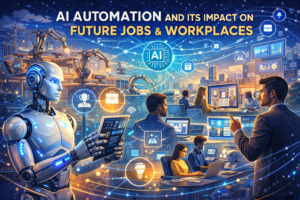
AI Automation and Workplace Productivity
AI automation significantly improves workplace productivity by reducing the time required to complete complex tasks. Automated systems can process large amounts of data quickly and accurately, enabling businesses to make faster decisions.
Employees also benefit from automation because it reduces repetitive workloads and allows them to focus on more meaningful activities. For example, AI-powered scheduling tools can organize meetings automatically, while data analysis software can generate insights from business data.
Benefits of AI automation in workplaces include:
-
Faster task completion
-
Reduced operational costs
-
Improved accuracy and efficiency
-
Better decision-making through data insights
These advantages make AI automation a valuable tool for modern organizations.
Challenges and Concerns of AI Automation
Despite its benefits, AI automation also raises several challenges and concerns. One major issue is job displacement, as some workers may struggle to transition into new roles. This concern highlights the need for effective workforce training and education programs.
Another challenge is the ethical use of AI technologies. Businesses must ensure that automated systems operate transparently and do not create bias or unfair outcomes. Data privacy and cybersecurity are also important considerations when using AI-powered systems.
Common concerns related to AI automation include:
-
Job displacement and workforce transitions
-
Ethical use of artificial intelligence
-
Data privacy and security risks
-
Dependence on automated systems
Addressing these challenges will be essential for responsible AI adoption.
The Future of AI-Powered Workplaces
The future workplace will likely involve close collaboration between humans and intelligent machines. AI systems will assist employees with complex tasks, analyze large datasets, and provide valuable insights for decision-making. Rather than replacing workers entirely, AI will enhance human capabilities.
Organizations will also adopt flexible work environments supported by digital technologies. Remote work, cloud-based collaboration tools, and automated workflows will become more common in many industries.
Future trends in AI-powered workplaces include:
-
Increased use of intelligent automation tools
-
Greater collaboration between humans and AI systems
-
Expansion of remote and digital workplaces
-
Integration of AI with emerging technologies
These trends indicate that AI will continue to shape the future of work.
Conclusion
AI automation is transforming the way businesses operate and how employees perform their jobs. While automation may replace some routine tasks, it also creates new opportunities for innovation and career growth. Industries that embrace AI technologies can achieve higher efficiency, productivity, and competitiveness.
Preparing for the future of work requires individuals and organizations to adapt to technological change. By investing in education, reskilling, and responsible AI practices, society can harness the benefits of automation while minimizing its challenges. The future workplace will be defined by collaboration between humans and intelligent machines, creating new possibilities for economic growth and innovation.