Education is experiencing a profound transformation as artificial intelligence (AI) becomes increasingly integrated into teaching and learning environments. Schools, universities, and training institutions are adopting AI-powered tools to enhance educational outcomes, personalize learning experiences, and improve administrative efficiency. These technologies are reshaping how students access information, how teachers deliver lessons, and how institutions manage educational resources.
In 2026, artificial intelligence is not only supporting traditional learning systems but also enabling entirely new forms of education. Adaptive learning platforms, intelligent tutoring systems, automated assessments, and data-driven insights are helping educators better understand student needs and provide more effective instruction. At the same time, AI technologies are making education more accessible to learners around the world.
Understanding how AI-powered tools are changing education helps educators, students, and policymakers prepare for a future where technology and learning are closely connected.
Personalized Learning Through AI Systems
One of the most significant contributions of artificial intelligence to education is the ability to create personalized learning experiences. Traditional classrooms often follow a single pace of instruction for all students, which can make it difficult to address individual learning differences. AI-powered platforms analyze student performance, learning styles, and progress to provide customized educational content.
Adaptive learning systems adjust lesson difficulty, suggest additional practice materials, and identify areas where students may need extra support. This allows learners to move through educational content at their own pace while focusing more time on challenging topics. As a result, students can build stronger foundational knowledge and improve overall academic performance.
Personalized learning also benefits teachers by providing detailed insights into student progress. Educators can quickly identify struggling students and offer targeted guidance, ensuring that no learner falls behind in the classroom.
Intelligent Tutoring Systems Enhancing Student Support
AI-powered tutoring systems are becoming an important supplement to traditional teaching methods. These digital tutors simulate one-on-one instruction by guiding students through lessons, answering questions, and providing feedback in real time. Intelligent tutoring systems can explain concepts in multiple ways, helping learners understand complex subjects more effectively.
Such systems are particularly useful for subjects like mathematics, science, and language learning, where students often require additional practice and clarification. AI tutors are available at any time, allowing students to study outside regular classroom hours and receive immediate assistance.
Another advantage of intelligent tutoring technology is its ability to track student progress over time. By analyzing learning patterns, these systems can recommend new exercises or learning strategies tailored to individual needs. This continuous feedback loop improves learning efficiency and helps students develop stronger problem-solving skills.
Automated Assessment and Grading
Assessment plays a crucial role in education, but grading assignments and exams can be time-consuming for teachers. AI-powered assessment tools are helping educators streamline this process by automatically evaluating certain types of student work. These systems can grade multiple-choice tests, analyze written responses, and provide detailed feedback within seconds.
Automated grading technologies use natural language processing to evaluate essays and written assignments based on factors such as grammar, coherence, and structure. While human teachers still review and interpret complex work, AI tools significantly reduce administrative workload.
By saving time on routine grading tasks, educators can focus more on teaching, mentoring, and developing creative lesson plans. Automated assessment also allows institutions to provide faster feedback to students, helping them understand mistakes and improve their performance more quickly.
AI-Powered Content Creation for Educators
Artificial intelligence is also supporting educators in creating teaching materials and lesson plans. AI-powered tools can generate quizzes, presentations, study guides, and interactive learning resources based on specific topics or curriculum requirements. These technologies help teachers design engaging educational content without spending excessive time on preparation.
For example, AI can analyze large educational databases and recommend relevant examples, case studies, or multimedia materials that enhance classroom instruction. Teachers can also use AI to adapt content for different skill levels, ensuring that lessons remain accessible to diverse groups of students.
Additionally, AI tools can assist in translating educational materials into multiple languages. This capability helps institutions reach a wider audience and supports international students who may prefer learning in their native languages.
Data Analytics Improving Educational Decision-Making
Educational institutions are increasingly using AI-driven data analytics to improve learning outcomes and institutional performance. AI systems can analyze large amounts of educational data, including attendance records, assessment results, and student engagement metrics.
These insights allow educators and administrators to identify patterns that may indicate learning challenges or academic risks. For instance, if a student shows declining performance or reduced participation, AI systems can alert educators so that they can intervene early and provide support.
Data analytics also helps institutions evaluate the effectiveness of teaching methods, curriculum design, and learning programs. By understanding which approaches produce the best results, schools and universities can continuously improve their educational strategies.
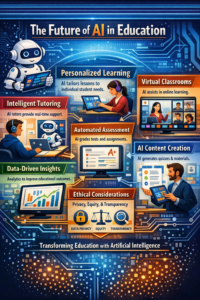
Virtual Classrooms and AI Learning Assistants
The growth of digital learning platforms has led to the development of virtual classrooms supported by AI technologies. In these environments, students participate in online lessons, collaborate with classmates, and access digital resources through integrated learning platforms.
AI-powered learning assistants help manage virtual classrooms by answering common questions, organizing course materials, and guiding students through assignments. These digital assistants can also remind students about deadlines, track progress, and suggest study schedules.
Virtual learning environments are particularly valuable for remote education and lifelong learning. Professionals seeking new skills can access online courses supported by AI technologies, allowing them to study flexibly while balancing work and personal responsibilities.
Ethical Considerations and Challenges
While AI offers many benefits for education, it also raises important ethical considerations. Issues such as data privacy, algorithm transparency, and equitable access to technology must be carefully addressed. Educational institutions must ensure that student data is protected and used responsibly.
Another challenge involves maintaining the balance between technology and human interaction. While AI can support learning processes, the role of teachers remains essential in guiding students, encouraging creativity, and fostering critical thinking skills.
Access to AI technologies can also vary between regions and institutions. Ensuring equal access to digital learning tools is crucial for preventing educational inequalities and ensuring that all students benefit from technological advancements.
The Future of AI in Education
The future of education will likely involve deeper integration of artificial intelligence across all aspects of learning. Emerging technologies such as immersive virtual learning environments, advanced language translation tools, and intelligent collaboration platforms will continue expanding educational opportunities.
AI may also play a larger role in career guidance by analyzing student interests, strengths, and academic performance to recommend suitable career paths or educational programs. These tools could help students make more informed decisions about their professional futures.
As technology continues to evolve, educators will increasingly combine traditional teaching methods with AI-powered tools to create more engaging and effective learning experiences.
Conclusion
Artificial intelligence is transforming education by introducing innovative tools that enhance teaching, learning, and educational management. Personalized learning platforms, intelligent tutoring systems, automated assessments, and data analytics are helping institutions provide more effective and accessible education.
While challenges related to ethics, data privacy, and technology access remain important considerations, the potential benefits of AI in education are substantial. These technologies empower educators to better understand student needs and support learners in achieving their academic goals.
As AI-powered tools continue to develop, the future of education will likely become more adaptive, inclusive, and technology-driven. By integrating artificial intelligence with human teaching expertise, educational institutions can create learning environments that prepare students for the demands of an increasingly digital world.
read more : recchiabegue.com
