Artificial Intelligence (AI) is rapidly transforming the healthcare industry by improving the accuracy, speed, and efficiency of medical diagnostics and treatment. Healthcare systems worldwide are increasingly adopting AI technologies to analyze complex medical data, support clinical decision-making, and detect diseases earlier than traditional methods. By processing vast amounts of patient information, medical images, and genetic data, AI systems help doctors identify patterns that may be difficult for humans to detect.
In recent years, AI has moved from experimental research to real-world medical applications. Hospitals and research institutions are using machine learning algorithms, predictive analytics, and intelligent automation to improve healthcare delivery and patient outcomes. AI tools can now analyze medical scans, predict disease risks, monitor patients remotely, and assist doctors in making more informed decisions.
The integration of AI in healthcare is not intended to replace medical professionals but to enhance their capabilities. When combined with human expertise, AI technologies create more accurate, efficient, and patient-centered healthcare systems.
Table of Contents
ToggleAI-Powered Medical Diagnostics
One of the most important applications of artificial intelligence in healthcare is medical diagnostics. AI algorithms can analyze medical images such as X-rays, CT scans, and MRI scans with remarkable accuracy, helping doctors detect diseases earlier and more reliably. Studies show that AI systems can diagnose certain cancers with around 95% accuracy and significantly reduce diagnostic errors in clinical practice.
Advanced AI imaging systems can detect subtle abnormalities in medical scans that might be overlooked during manual analysis. For example, AI models analyzing chest X-rays have demonstrated precision rates above 98% while identifying multiple diseases simultaneously. These tools help radiologists review scans faster and prioritize critical cases.
By improving diagnostic accuracy and speed, AI-powered imaging systems are helping healthcare providers deliver earlier treatment and better patient outcomes.
Early Detection of Diseases
Early detection is one of the most significant advantages AI brings to healthcare. Machine learning models can analyze patient records, imaging data, and laboratory results to identify early warning signs of diseases such as cancer, heart disease, and neurological disorders.
AI-based diagnostic tools are already being used to detect conditions like diabetic retinopathy and breast cancer with high accuracy. In several clinical trials, AI-assisted mammography achieved sensitivity rates of over 90%, allowing doctors to detect tumors at earlier stages. Early diagnosis is critical because it significantly improves survival rates and reduces treatment costs.
AI is also being used in innovative diagnostic devices. Researchers have developed AI-powered medical tools capable of detecting heart conditions within seconds by analyzing heart sounds and electrocardiogram signals. Such technologies enable faster diagnosis and allow doctors to begin treatment earlier.
Medical Imaging and Radiology
Radiology is one of the medical fields where AI has had the greatest impact. Every day, radiologists must review thousands of medical images, which can be time-consuming and prone to human error. AI systems can process these images quickly and highlight areas that require closer examination.
Machine learning algorithms are capable of detecting tumors, fractures, infections, and internal bleeding with high precision. In some studies, AI systems analyzing CT scans and imaging data achieved more than 94% accuracy in distinguishing between benign and malignant lung nodules.
AI-assisted radiology also improves workflow efficiency in hospitals. Automated analysis reduces the workload of radiologists and shortens the time needed to interpret medical scans. As a result, doctors can focus more on complex cases and patient consultations rather than routine image analysis.
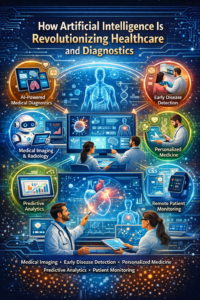
Personalized Medicine and Treatment Planning
Artificial intelligence is also playing a major role in personalized medicine. Traditional medical treatments often follow a standard approach, but AI enables healthcare providers to tailor treatments based on an individual patient’s genetic makeup, lifestyle, and medical history.
AI systems analyze large datasets that include genetic information, environmental factors, and clinical records to recommend personalized treatment strategies. This approach, known as precision medicine, allows doctors to choose therapies that are most likely to be effective for each patient.
For example, AI models can analyze genomic data to determine which cancer treatments may work best for a specific patient. By predicting how individuals will respond to different medications, AI helps reduce ineffective treatments and improves recovery outcomes.
Predictive Analytics and Disease Prevention
Another important application of AI in healthcare is predictive analytics. AI models analyze historical patient data to predict the likelihood of diseases, hospital readmissions, or medical complications. This predictive capability allows healthcare providers to take preventive action before a condition becomes severe.
Predictive AI tools can identify patients who are at risk of developing conditions such as sepsis, diabetes, or heart disease. Some systems can forecast medical emergencies hours in advance, giving doctors valuable time to intervene and prevent complications.
Healthcare organizations are increasingly using predictive analytics to improve public health management. AI can analyze large datasets including environmental factors, travel patterns, and disease surveillance data to predict potential outbreaks and enable early response measures.
Remote Patient Monitoring and Digital Health
Artificial intelligence is also transforming patient monitoring through wearable devices and digital health platforms. Smartwatches, biosensors, and remote monitoring systems collect real-time health data such as heart rate, oxygen levels, and blood pressure.
AI algorithms analyze this continuous stream of data and alert healthcare providers when abnormal patterns appear. This enables doctors to monitor patients remotely and intervene quickly if health conditions worsen. Remote monitoring has been particularly useful for managing chronic diseases such as diabetes, cardiovascular conditions, and respiratory illnesses.
AI-driven monitoring systems also reduce the need for frequent hospital visits. By identifying health issues early, these technologies help prevent emergencies and improve long-term patient care.
Drug Discovery and Medical Research
Artificial intelligence is accelerating the process of drug discovery and medical research. Developing new medications traditionally requires years of laboratory research and clinical trials. AI can analyze millions of molecular compounds and predict which ones are most likely to become effective drugs.
Researchers use machine learning algorithms to simulate chemical interactions, identify promising drug candidates, and predict potential side effects. This significantly reduces the time and cost associated with pharmaceutical research.
AI is also helping scientists discover new uses for existing medications, a process known as drug repurposing. By analyzing medical data and biological interactions, AI systems can identify treatments that may be effective for diseases beyond their original purpose.
Ethical Challenges and Data Privacy
Despite its many advantages, the use of AI in healthcare raises several ethical and regulatory concerns. One major issue is data privacy. AI systems require access to large amounts of patient data, including medical records and genetic information. Healthcare institutions must ensure that this data is securely stored and used responsibly.
Another challenge is algorithmic bias. If AI models are trained on limited or unbalanced datasets, they may produce inaccurate results for certain populations. Researchers are working to improve data diversity and implement bias detection systems to ensure fairness in AI-based diagnostics.
Healthcare experts also emphasize the importance of maintaining human oversight. AI tools should support doctors rather than replace them. The most effective healthcare systems combine AI-driven analysis with the experience and judgment of medical professionals.
The Future of AI in Healthcare
The future of healthcare will likely involve deeper integration of artificial intelligence across clinical practice, research, and patient management. Emerging technologies such as AI-driven robotics, advanced imaging systems, and intelligent medical assistants are expected to further enhance healthcare delivery.
As AI systems become more sophisticated, they will continue improving disease detection, treatment planning, and hospital operations. These innovations will help healthcare providers deliver more efficient, accessible, and personalized medical care.
Ultimately, artificial intelligence has the potential to transform healthcare from a reactive system that treats illness into a proactive system that prevents disease and promotes long-term wellness. By combining advanced technology with human expertise, the healthcare industry can build a more effective and sustainable future for global health.
Read more : digisoftron.com